
Sequencing TOK Essay Teaching Strategies for Maximum Student Impact
The International Baccalaureate Diploma Programme has long been recognized for its rigorous academic standards. According to recent data from the International Baccalaureate Organisation, the global pass rate for the Diploma Programme consistently hovers around 85% in recent years. However, the Theory of Knowledge (TOK) essay remains a significant hurdle for many students. This course challenges learners to reflect on the nature of knowledge itself. It requires them to analyze how knowledge is constructed, validated, and applied. Effective sequencing of teaching strategies is not merely a logistical choice. It is a pedagogical necessity that determines whether a student produces a superficial analysis or a profound epistemological inquiry.
Understanding the Epistemological Basis
Before implementing specific teaching strategies, educators must understand the core objective of the TOK essay. The essay is not a research paper. It does not seek to prove a factual truth. Instead, it asks students to evaluate the validity of knowledge claims. Knowledge is the justified true belief that is accepted as fact. In the context of TOK, this definition is constantly tested. Students must explore how different Areas of Knowledge (AOKs) such as History, Natural Sciences, or the Arts, produce knowledge differently.
Sequencing is critical because students often struggle with the abstract nature of the prompt. If teachers jump straight to writing structure, students lack the conceptual framework to generate meaningful content. The initial phase must focus on epistemological literacy. This involves defining key terms like evidence, justification, and perspective. Without this foundation, subsequent lessons on argumentation will lack depth. Educators should utilize resources from IB official TOK guides to ensure alignment with current assessment criteria.
Phase 1: Deconstructing the Title
The first stage of the teaching sequence involves breaking down the prescribed title. Students are often overwhelmed by the length and complexity of the prompt. The teacher's role here is to act as a guide, helping students identify the key concepts. For example, a title might ask, "Does some knowledge belong only to particular communities of knowers?" The teacher must help students isolate "knowledge," "belong," and "communities of knowers." During this phase, use the IB workshops available through Ibicus to learn advanced deconstruction techniques. These sessions often provide practical tools for helping students navigate complex philosophical questions. Encourage students to define terms in their own words. This prevents them from relying on generic dictionary definitions that do not fit the specific context of the essay.
Once the terms are defined, students must identify the central tension in the title. This tension is the engine of the essay. It creates the need for inquiry. If there is no tension, there is no argument. Teachers should facilitate group discussions where students propose different interpretations of the title. This collaborative approach mirrors the collaborative atmosphere that Ibicus promotes in its training programs.
Phase 2: Developing Claims and Counterclaims
With the title deconstructed, the next step is generating knowledge questions. These questions drive the exploration of the essay. A strong knowledge question is open-ended and does not have a simple yes or no answer. It invites analysis and evaluation. For instance, instead of asking "Is history true?", a better question is "How does the selection of evidence shape historical knowledge?"
Students must then develop claims and counterclaims for each knowledge question. This is where the concept of perspective becomes vital. Perspective is the way in which something is regarded, considered, or interpreted. In TOK, no knowledge is neutral. Every knower brings a specific viewpoint based on their culture, discipline, and experience. Teachers should guide students to identify these perspectives explicitly.
Use real-world examples to ground these abstract concepts. For example, when discussing the Natural Sciences, examine how peer review acts as a mechanism for validating knowledge. When discussing the Arts, explore how subjective interpretation challenges the notion of objective truth. These examples make the abstract tangible. They allow students to see the relevance of TOK to their daily lives. This approach aligns with the masterclasses offered by Ibicus, which focus on practical application of IB frameworks.
Phase 3: Structuring the Argument
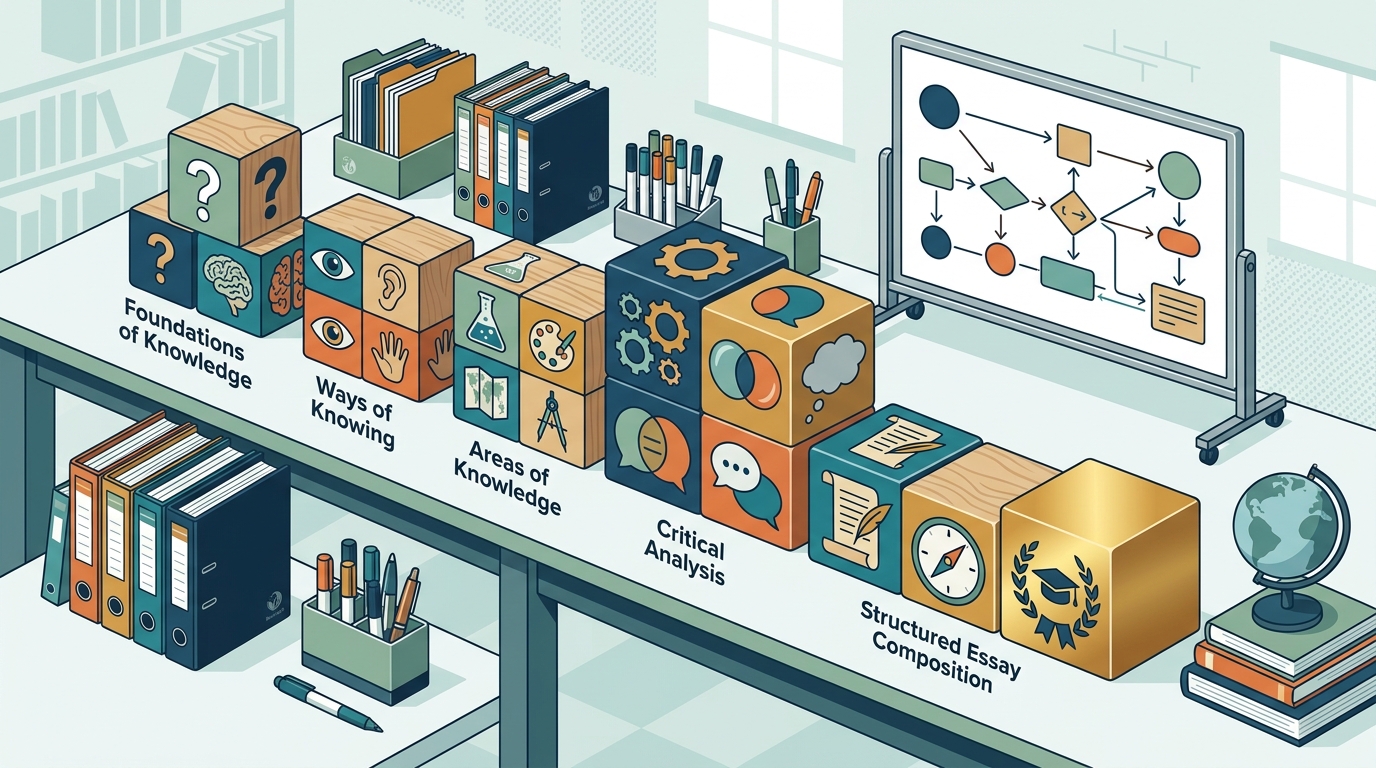
Once students have their claims and counterclaims, they must organize them into a coherent structure. The most effective structure for a TOK essay is thematic. Instead of dedicating one paragraph to each Area of Knowledge, students should organize their essay around the key concepts identified in Phase 1. This ensures that the essay remains focused on the title rather than drifting into a general discussion of the AOKs.
Each paragraph should follow a clear logic. Start with a claim. Provide evidence from a specific AOK. Analyze the implications of this evidence. Then, introduce a counterclaim. Show how the counterclaim challenges the initial claim. Finally, evaluate which perspective is more compelling. This evaluation is the heart of the TOK essay. It demonstrates critical thinking. It shows that the student understands the complexity of knowledge.
Teachers should provide templates and graphic organizers to help students visualize this structure. These tools reduce cognitive load and allow students to focus on the quality of their analysis. Regular feedback loops are essential during this phase. Use peer review sessions where students critique each other's outlines. This builds their ability to evaluate arguments objectively. It also reinforces the learning community aspect of the IB Diploma Programme.
Phase 4: Refining the Conclusion
The conclusion is often the most challenging part of the TOK essay. Students frequently summarize their points rather than synthesizing them. A strong conclusion does not just repeat the arguments. It answers the knowledge question posed by the title. It provides a nuanced final judgment based on the evidence presented.
Encourage students to reflect on the implications of their analysis. What does this tell us about the nature of knowledge? Are there limitations to our current understanding? This reflective step elevates the essay from a simple analysis to a profound inquiry. It demonstrates the student's ability to think like a philosopher.
Teachers should model the writing of a conclusion. Show students how to transition from specific examples to broader epistemological insights. This modeling is a key component of the teacher training programmes provided by Ibicus. By observing expert facilitators, teachers can learn how to scaffold this complex cognitive task for their students.
Comparing Teaching Methodologies
Different teaching methodologies can be employed to support the sequencing of TOK essay instruction. The table below compares three common approaches.
| Methodology | Description | Best For | Pros | Cons |
|---|---|---|---|---|
| Direct Instruction | Teacher-led lectures on TOK concepts and essay structure. | Introducing new concepts. | Clear, efficient delivery of core content. | Passive learning; limited student engagement. |
| Inquiry-Based Learning | Students explore knowledge questions through research and discussion. | Developing critical thinking. | High engagement; promotes deep understanding. | Time-consuming; requires strong facilitation skills. |
| Collaborative Workshop | Small groups work together to analyze prompts and draft essays. | Refining arguments and structure. | Peer learning; diverse perspectives. | Can lead to groupthink if not managed well. |
Each methodology has its place in the teaching sequence. Direct instruction is useful for the initial introduction of concepts. Inquiry-based learning is ideal for the development of claims and counterclaims. Collaborative workshops are effective for refining structure and content. A blended approach, often facilitated through specialist training, yields the best results.
Key Takeaways
- Sequencing is Critical: Teaching the TOK essay requires a logical progression from concept definition to argument structure.
- Deconstruction First: Students must understand the title before they can write about it. This prevents superficial responses.
- Perspective Matters: Explicitly teaching the role of perspective helps students generate nuanced claims and counterclaims.
- Thematic Structure: Organizing essays by concept rather than by AOK ensures a tighter focus on the title.
- Feedback Loops: Regular peer and teacher feedback is essential for refining arguments and structure.
- Professional Development: Utilizing IB workshops can enhance teacher confidence in delivering TOK content.
- Global Context: TOK is taught in over 130 countries, requiring adaptable teaching strategies that respect diverse cultural contexts.
Frequently Asked Questions
How long should a TOK essay be?
The TOK essay should be between 1,600 and 1,800 words. This length allows for sufficient depth of analysis without becoming overly verbose. Staying within this limit is crucial for meeting IB assessment criteria.
What is the difference between a claim and a counterclaim?
A claim is a statement that supports a particular interpretation of the title. A counterclaim challenges this interpretation. Both are necessary to demonstrate critical thinking and a balanced analysis of knowledge.
How can teachers support students with anxiety about the TOK essay?
Teachers can reduce anxiety by breaking the essay down into manageable steps. Providing clear templates and modeling the process helps students feel more confident. Regular check-ins and positive reinforcement are also effective strategies.
Is it better to teach TOK as a standalone course or integrated with other subjects?
While TOK is a standalone course, integrating it with other subjects can provide rich examples for analysis. However, the core epistemological concepts must be taught explicitly to ensure students understand the unique nature of TOK inquiry.
What role does the Internal Assessment play in TOK?
The TOK exhibition is the internal assessment component. It requires students to analyze three objects in relation to a prescribed title. This complements the essay by focusing on the application of knowledge in real-world contexts.
How often should TOK workshops be held?
Workshops should be held regularly throughout the course. Frequent, short sessions are often more effective than occasional long lectures. This allows for continuous feedback and adjustment of student understanding.
What resources are available for IB teachers?
Resources include the official IB TOK guide, past exam papers, and professional development workshops. Organizations like Ibicus offer specialized training to help teachers navigate these resources effectively.
Book Your Workshop
Mastering the teaching of the TOK essay requires both theoretical knowledge and practical skill. Ibicus offers a range of professional development workshops designed to support IB educators. These workshops provide strategies for sequencing instruction, deconstructing titles, and fostering critical thinking in students. Whether you are new to teaching TOK or looking to refine your approach, our programs offer valuable insights. Visit our booking page to find a workshop that suits your needs. Connect with the Ibicus team today to enhance your teaching practice and support your students in achieving maximum impact.