

Teachers should guide students through unpacking a challenging Theory of Knowledge (TOK) essay title by deconstructing the prompt into its core knowledge questions, identifying the specific Areas of Knowledge (AoKs), and clarifying the role of key terms. This process shifts the focus from content recall to epistemological analysis. By modeling this breakdown explicitly, educators help students move beyond surface-level summaries to construct a rigorous, argument-driven essay that addresses the IBO's specific assessment criteria.
Deconstructing the Prompt Structure
A TOK essay title is is a carefully constructed sentence that contains multiple layers of meaning. It is not a simple question to be answered with a yes or no, but a statement that invites investigation. Teachers must train students to identify the grammatical structure of the title, distinguishing between the main claim and the supporting conditions. For example, a title might assert a relationship between two AoKs, requiring the student to evaluate the strength of that connection.
The first step in unpacking is to isolate the key terms. These are the words that carry the most weight in the essay. A term like 'knowledge' or 'truth' has a specific philosophical definition that differs from its everyday usage. By defining these terms early, students set the boundaries of their argument. This prevents the common error of drifting into a general discussion of a subject without addressing the epistemological core of the prompt.
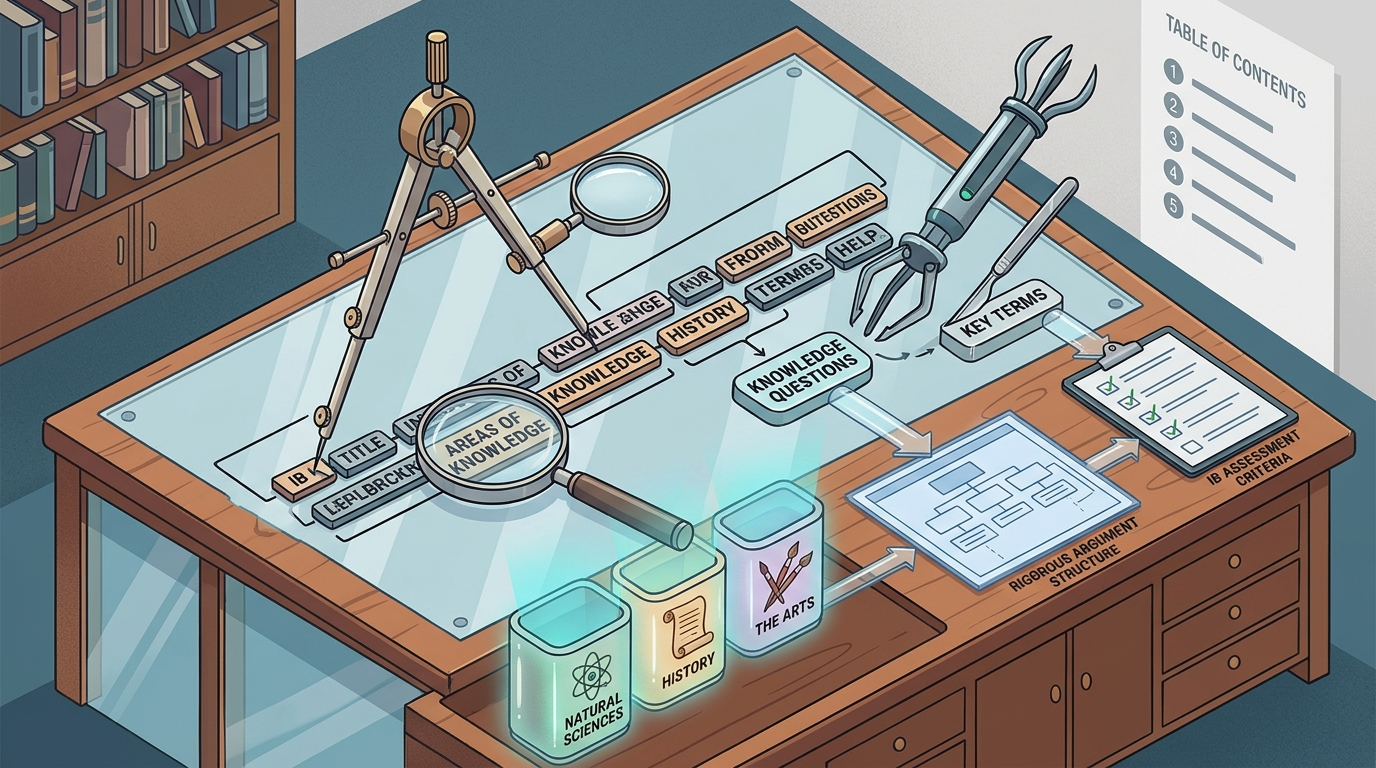
Teachers can use a visual mapping tool to show how the terms interact. This helps students see the logical flow of the title. If the title uses a conditional phrase, such as 'if' or 'when', the student must address those specific conditions. Ignoring these nuances leads to a weak thesis that fails to engage with the full complexity of the question.
Identifying the Areas of Knowledge
Areas of Knowledge (AoKs) are the distinct domains of human inquiry, such as mathematics, natural sciences, or history. The TOK essay requires students to select two AoKs to explore. The choice of AoKs is not arbitrary; it must be relevant to the key terms in the title. Teachers should guide students in selecting AoKs that offer a productive contrast or complement to each other.
For instance, if the title involves 'certainty', comparing mathematics and history provides a strong framework. Mathematics offers a model of deductive certainty, while history relies on inductive reasoning and interpretation. This contrast allows for a deeper analysis of how knowledge is constructed in different fields. Students often struggle with this selection, choosing AoKs that are too similar or too broad. A structured approach to selection ensures that the essay remains focused and manageable.
It is also important to consider the specific knowledge (SK) within each AoK. While the essay is about knowledge in general, examples from specific subjects help ground the argument. Teachers should encourage students to think of concrete examples that illustrate the broader epistemological points. This balance between general theory and specific evidence is crucial for a high-scoring essay.
Defining Key Terms with Precision
Key terms are the conceptual anchors of the TOK essay. They are words like 'objectivity', 'bias', or 'evidence' that require precise definition. A key term is not just a vocabulary word; it is a concept with a specific philosophical meaning. Teachers must help students understand that the definition of a term can vary depending on the AoK. For example, 'objectivity' in the natural sciences might mean reproducibility, while in the arts it might mean authenticity.
Students often make the mistake of using a single, static definition for a key term throughout the essay. This is a significant error because it ignores the context-dependence of knowledge. Teachers should model how to define a term in relation to a specific AoK. This shows the examiner that the student understands the nuance of the concept. It also allows for a more sophisticated argument that acknowledges different perspectives.
Using a dictionary definition is usually insufficient for a TOK essay. Instead, students should look for definitions that are relevant to the field of knowledge. This requires a deeper engagement with the subject matter. Teachers can provide a list of common key terms and their potential definitions in different AoKs to help students prepare. This resource can be a valuable tool for students as they draft their essays.
Constructing a Focused Thesis
A thesis statement is a concise summary of the main argument of the essay. In TOK, the thesis must directly address the prompt and take a clear position. It is not enough to say that the title is complex; the student must argue for a specific interpretation. Teachers should guide students in crafting a thesis that is arguable and specific. A weak thesis is one that is too broad or too vague to be supported by evidence.
Teachers can use peer review to help students refine their theses. By sharing their drafts with classmates, students can get feedback on the clarity and strength of their argument. This process helps them identify gaps in their reasoning. It also encourages them to think critically about their own work. A well-crafted thesis is the foundation of a strong TOK essay.
Key Takeaways
- Deconstruct the title into its grammatical and conceptual components to identify the core question.
- Select two Areas of Knowledge that offer a productive contrast or complement to each other.
- Define key terms with precision, acknowledging their context-dependence in different AoKs.
- Craft a thesis that is arguable, specific, and directly addresses the prompt.
- Use specific knowledge examples to ground abstract epistemological arguments.
- Model the unpacking process explicitly to help students develop their own analytical skills.
Frequently Asked Questions
What is the first step in unpacking a TOK essay title?
The first step is to read the title carefully and identify the key terms and the Areas of Knowledge mentioned or implied. This initial analysis helps students understand the scope of the essay.
How many Areas of Knowledge should a student choose?
Students must choose exactly two Areas of Knowledge for their TOK essay. The choice should be relevant to the key terms in the title.
Why is defining key terms important?
Defining key terms is important because it sets the boundaries of the argument and shows the examiner that the student understands the philosophical concepts involved.
Can a student change their thesis during the writing process?
Yes, a student can change their thesis as they develop their argument. The thesis should evolve to reflect the depth of the analysis.
What is the role of specific knowledge in a TOK essay?
How can teachers help students who struggle with abstract concepts?
Teachers can use visual aids, analogies, and real-world examples to make abstract concepts more accessible. They can also provide scaffolding through guided practice.
Conclusion
Guiding students through the unpacking of a challenging TOK essay title is a critical skill for IB teachers. By focusing on the structure of the prompt, the selection of Areas of Knowledge, and the precise definition of key terms, educators can help students develop the analytical skills needed for success. This process not only improves essay scores but also deepens students' understanding of the nature of knowledge. Ibicus offers specialized training for IB teachers, providing the tools and expertise needed to support students in their TOK journey. To explore our range of workshops and masterclasses, visit our home page or for more information.